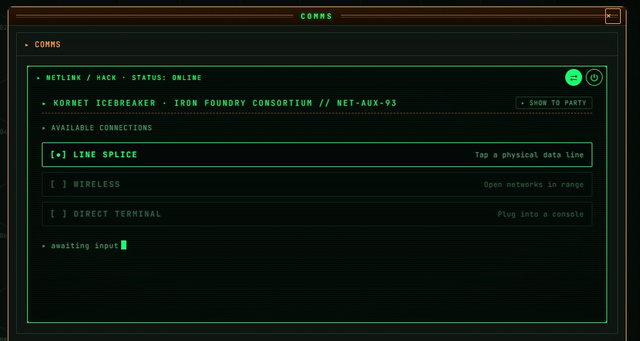
How Does Hacking Work in Stars Without Number?
Hacking resolves as skill checks against a target system, with countermeasures that trace, lock out, or raise an alarm. Here is the flow, and how to run it so four other players are not waiting.
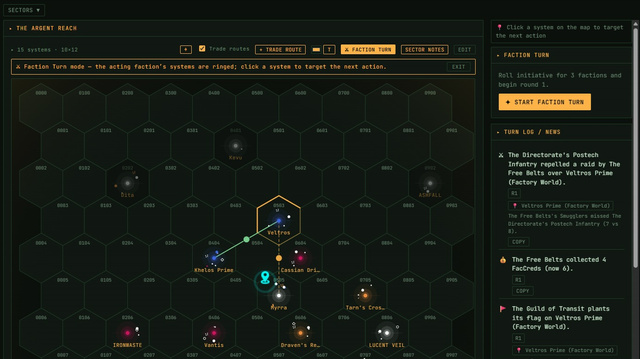
Sandbox sci-fi — sectors, factions, hacking
Sector maps, faction turns, starship combat, and a hacking minigame that plays out live at the table — built for the sandbox sci-fi you're already running.
Drop pins on a hex-grid sector map and every system carries its own world detail — atmosphere, biosphere, tech level, the tags that make a planet feel like somewhere instead of a stat block. Trade routes connect the systems your players actually visit, and the party's ship shows up as a live pin the whole table can see.
It's the same sandbox toolkit from the tabletop rules, just faster to run — no more flipping between three notebooks mid-session to remember which moon has the black-market shipyard.
Every faction on the map tracks its own goals, assets, and members, and faction turns resolve in the same tool where you run everything else — no side spreadsheet, no forgetting whose turn it was.
Influence and assets update live, so the political map your players are scheming against is always current, not three sessions stale.
Deck plans, weapons, and cargo live on the same ship sheet your party already knows, and combat plays out on the same initiative tracker you use for a bar fight — no separate ship-combat module to relearn.
Cyberdecks build attack packets, the GM builds defenses, and the exchange animates live at the table — tense, visible, and fast enough that hacking doesn't stall the session while everyone waits on one player's spreadsheet math.
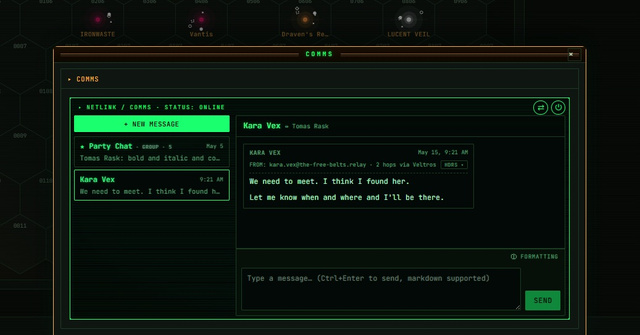
Per-NPC comms threads gate on range and FTL lag, so a message to the far side of the sector actually takes time to arrive. It turns "call for backup" into a real tactical decision instead of an instant chat ping.
An initiative strip keeps combat moving, and a canvas battle map lets you drag stamps, save the layout, and load it again next session — the tactical layer is there when a fight needs it, and out of the way when it doesn't.
Hacking resolves as skill checks against a target system, with countermeasures that trace, lock out, or raise an alarm. Here is the flow, and how to run it so four other players are not waiting.
How to run faction turns in the Stars Without Number VTT — creating factions, assigning assets, resolving turn actions, and the reasons most tables quietly drop the subsystem after three sessions.
A feature tour tells you almost nothing about a virtual tabletop. One real session tells you almost everything. Here is what to test, in what order, and how to do it without paying.
Direct, broadcast and encrypted traffic, who can intercept what, and how communication range limits it. Plus the part that matters more: using transmissions to set a scene before anyone speaks.
One game, free forever — no card, no countdown, no expiry. Support the project and the caps lift instantly, content carried over.
This product is an independent product compatible with Stars Without Number by Kevin Crawford / Sine Nomine Publishing. Stars Without Number is the property of Sine Nomine Publishing. This product is not affiliated with or endorsed by Sine Nomine Publishing.