How Does Hacking Work in Stars Without Number?
Short answer
A hacker picks a target system, then rolls skill checks to move deeper through its nodes. Failed checks and wasted rounds trigger countermeasures: a trace that locates them, a lockout that closes the node, or an alert that tells the building. The rules are simple. The hard part is pacing, because a hack is a solo minigame running inside a group activity.
How Does Hacking Work in Stars Without Number?
Hacking resolves as a series of skill checks against a target system. The hacker moves node by node toward an objective, each node gated by a roll against the system's difficulty, while countermeasures wait to trace them, lock a node, or wake the building up. That is the whole rules answer, and it takes about a minute to learn.
The part nobody tells you is that hacking is the subsystem most likely to produce a great scene and most likely to produce twenty minutes of one player rolling dice while everyone else checks their phone. Which one you get is a prep and pacing question, not a rules question. So this covers the flow first, then the pacing, which is the part that actually decides whether the scene works.
The Hacking Flow
- The GM sets up a system. Every hackable target — a starship computer, a facility network, a corporate server — is a System object. It gets a difficulty rating, a set of locked nodes such as data stores, access points and cameras, and optional countermeasures.
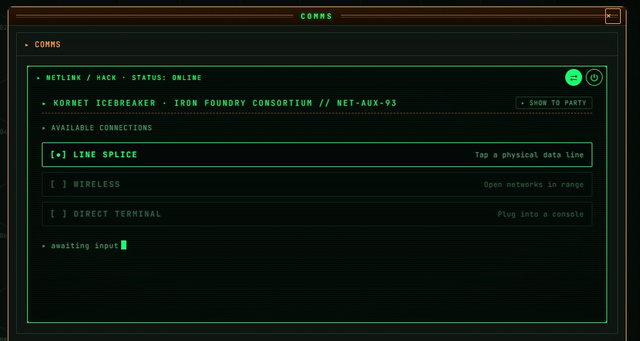
- The player initiates an intrusion. The hacker picks a target from the comms panel and clicks Intrude, which opens a visual node map of the system.
- Skill checks gate each node. Moving deeper means rolling against the system's difficulty. Fail and you may trip something.
4. Countermeasures fire. If the GM placed countermeasures, failing a check or spending too many rounds can trigger: - Trace: the system starts working out where the hacker physically is - Lockout: the node closes and reopening it is harder - Alert: people in the building find out
- The objective completes, or the hacker runs. At the target node they can extract data, open a door, disable a turret, or plant false orders — then jack out clean, or get traced back to a body sitting in a maintenance closet.
The Pacing Problem
A hacking scene is a solo minigame happening inside a group activity. The default failure mode is that one player plays a small strategy game for fifteen minutes and four other people wait.
Three things fix it, in order of how much they help:
Put the hack on a clock that everyone shares. The hacker isn't working in a vacuum — a guard patrol is coming round, the shuttle leaves in six minutes, the party is holding a door. When each node check advances the same clock the rest of the table is racing, the other players are not waiting, they're in the same scene from a different angle.
Cut the node count. Three nodes is a scene. Eight nodes is homework. If you want a hack to feel deep, make one node consequential rather than adding five shallow ones.
Give the other players something to affect. A physical distraction, a spliced cable, a bribed operator — anything that lets someone else's action change a check the hacker makes. Even one available assist turns spectators into participants.
GM Setup Tips
Keep systems small for the first few sessions. Entry, data store, exit teaches the flow without anyone getting lost.
Use countermeasures sparingly. One trace on the deepest node creates real tension. Countermeasures on every node create a slog where failure is ambient and stops meaning anything.
Name your nodes. "Personnel Records" and "Security Overrides" get players invested. "Node 3" does not. This costs you nothing and it is the single highest-return thing on this list.
Decide what failure costs before they roll. If you don't know what a failed check does to the fiction, the answer defaults to "nothing happens, roll again", which is where hacking scenes go to die. Every check should move something — the clock, the alarm state, what the party knows.
Let a good roll skip a node. Nothing says you have to make them work through every layer. A strong result that collapses two nodes into one is a reward the system supports and players remember.
Player Tips
Specialise or stay shallow. A character built to do this can attempt real targets. A character who picked up the skill incidentally should be hitting low-security systems, and that's fine — a cargo manifest is a legitimate objective.
Ask what you're looking at before you commit. The GM can describe a system's shape and purpose without telling you its difficulty. That description usually tells you whether this is worth the risk.
Time is the resource, not the roll. You can usually buy a better chance by spending longer inside, and every extra round is another opportunity for something to notice you. Deciding when to stop is the actual skill.
Have an exit plan before you go in. Knowing what you do when a trace fires is worth more than a higher bonus.
Where It Lives in the VTT
The hacking interface is in the Comms tab. If Intrude doesn't appear when you select a system, the GM needs to enable hacking in that system's settings.
The comms system guide covers the rest of that panel — interception, encryption, and running transmissions as an NPC — which is where a lot of hacking scenes start.
Related questions
- How does hacking work in Stars Without Number?
- The hacker selects a target system and rolls skill checks to move through its nodes toward an objective, such as a data store or a door control. Each node is gated by a check against the system difficulty. Failing a check, or spending too long inside, can trigger a trace, a lockout, or an alert.
- What skill do you use to hack in Stars Without Number?
- Intrusion attempts run off the character’s computer or hacking skill against the target system’s difficulty rating. A character who specialised in it can attempt real targets; one who picked the skill up incidentally should be aiming at low-security systems like cargo manifests, which are still legitimate objectives.
- How do you stop a hacking scene from boring the rest of the table?
- Put the hack on a clock the whole party shares, so every node check advances the same timer the other players are racing. Cut the node count to three. Give at least one other player an action that can change a check the hacker makes. Those three fixes, in that order, do almost all the work.
- How many nodes should a hackable system have?
- Three is a scene. Eight is homework. If you want a hack to feel deep, make one node consequential rather than adding five shallow ones.