How Do Ship Comms Work in Stars Without Number?
Short answer
Ship comms come in three kinds: direct to one recipient, broadcast to everyone in the system, and encrypted, which shows as unreadable traffic to anyone listening in. Any ship with a comms rating can intercept broadcasts and unencrypted direct traffic; reading encrypted traffic takes a check against the sender’s encryption level. Range is enforced, so a message that cannot reach cannot be sent.
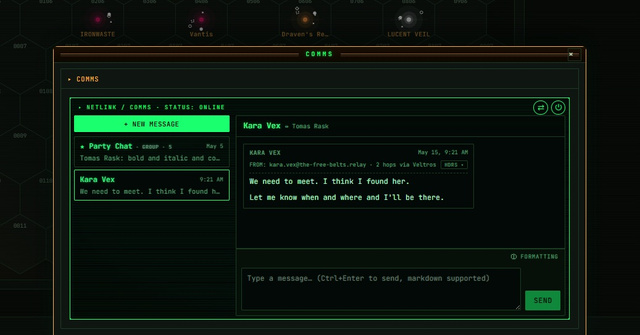
How Do Ship Comms Work in Stars Without Number?
Three kinds of transmission, and the difference between them is who else can read it. Direct traffic goes to one recipient. A broadcast is a general hail that everyone in the system sees. Encrypted traffic reaches its recipient intact and shows to everyone else as an encrypted transmission they would have to crack. Range is enforced on all three, so whether a message can arrive at all is a question with an answer rather than an argument.
Most of what happens in a space campaign happens over the radio. Distress calls, negotiations, the customs officer asking why your transponder says something different from your paperwork. Those are scenes, and they work better when the table can see the traffic rather than being told about it. So this covers the mechanics first, then how to use them for pacing, which is where the feature earns its place.
The Basics
The Comms panel, from the top nav in any session, handles ship-to-ship and ship-to-station communication. Anything sent through it lands in a feed the table can see.
Sending a Message
Open Comms and click Compose. Three kinds:
- Direct: visible only to the recipient ship or station
- Broadcast: a general hail, visible to everyone in the system
- Encrypted: shows as an encrypted transmission to anyone intercepting it, with only the intended recipient seeing the contents
Interception
Any ship with a comms rating can intercept broadcasts and unencrypted direct traffic between other ships in the same system. Open the Intercept tab and select Monitor Traffic to passively read everything that isn't protected.
Intercepting encrypted traffic requires a check against the sender's encryption level. The VTT resolves the roll and shows you the outcome.
Composing as an NPC
GMs can send from any NPC ship or station on the session roster. Open Compose, use the From dropdown, pick the contact. It arrives in the feed under their name and designation.
This is the feature that does the most work. Distress calls, bounty hails, corporate directives, sector news — all of it arrives in the same channel the players use, which means it reads as part of the world rather than as the GM talking.
Range and the FTL Overlay
The system enforces communication range. Same system, always. Adjacent systems, only if both ends have the range for it. The FTL range overlay, toggled from any contact's system profile, draws the coverage on the sector map so nobody has to argue about whether a message could have arrived.
That constraint is worth protecting. A party that can call anyone from anywhere has no reason to travel and no reason to worry. A party that has to physically move to get a message out has a map that matters.
Using Comms for Pacing
Open the session with traffic already in the feed. Two or three messages waiting when players log in — a job offer, a warning, something mundane that turns out not to be — sets the state of the world before anyone has to be told it.
Let the party overhear things they shouldn't. Interception is the most underused feature here. Something the players learn by listening in is worth more than the same information handed over, because they chose to go looking and they have to decide what to do with it.
Encrypt what matters. Encryption is a signal to players as much as a mechanic. Traffic they cannot read is a flag saying there is something here, and it converts a passive scene into a decision about whether to spend effort cracking it.
Do not run a whole negotiation through text. Written comms are excellent for setup, hooks, and information the party has to act on. A live back-and-forth is better spoken. Use the channel to start the scene, then play it out.
Give recurring NPCs a voice in the feed. A contact who messages the party every few sessions becomes a person. The From dropdown makes that nearly free.
Signal Delay
FTL comms are instantaneous inside range. They do not propagate across the whole sector on their own. If you want light-speed drama — a distress call from the sector edge that is hours old by the time it lands — tag the outgoing message as delayed and deliver it manually on your own timer. Native delay scheduling is on the list, not in yet.
Related
The hacking guide covers the Intrude side of this panel, which is where interception usually turns into something more involved. The sector map guide covers the range overlay in the context of the map it draws on.
Related questions
- How do ship communications work in Stars Without Number?
- Messages are direct, broadcast or encrypted. Direct traffic is visible only to the recipient ship or station, a broadcast is a general hail everyone in the system sees, and encrypted traffic appears to interceptors as an encrypted transmission with only the intended recipient seeing the contents.
- Can you intercept transmissions in Stars Without Number?
- Yes. Any ship with a comms rating can passively monitor broadcasts and unencrypted direct traffic between other ships in the same system. Intercepting encrypted traffic requires a check against the sender’s encryption level.
- How far can you communicate in Stars Without Number?
- Always within the same system. Reaching an adjacent system only works if both ends have the range for it. That constraint is worth protecting, because a party that can call anyone from anywhere has no reason to travel.
- Is there a signal delay for comms across a sector?
- FTL comms are instantaneous inside range and do not propagate across the whole sector on their own. If you want a distress call from the sector edge that is hours old by the time it lands, tag the message as delayed and deliver it on your own timer. Automatic delay scheduling is not built yet.