◆ Free · Two decks · 108 cards · 324 effects

Critical Hit& Critical FailDecks

For the two rolls nobody forgets

Double dice is a dull reward for a natural 20, and “you miss” is a dull end to a natural 1. Print both decks. On a 20 the hit pushes, pins, blinds or burns. On a 1 a sword slips, a bowstring snaps or a spell bursts into petals. Three effects on every card, one each for melee, ranged and spells.

Both decks · three looks · Letter and A4 · unsubscribe any time

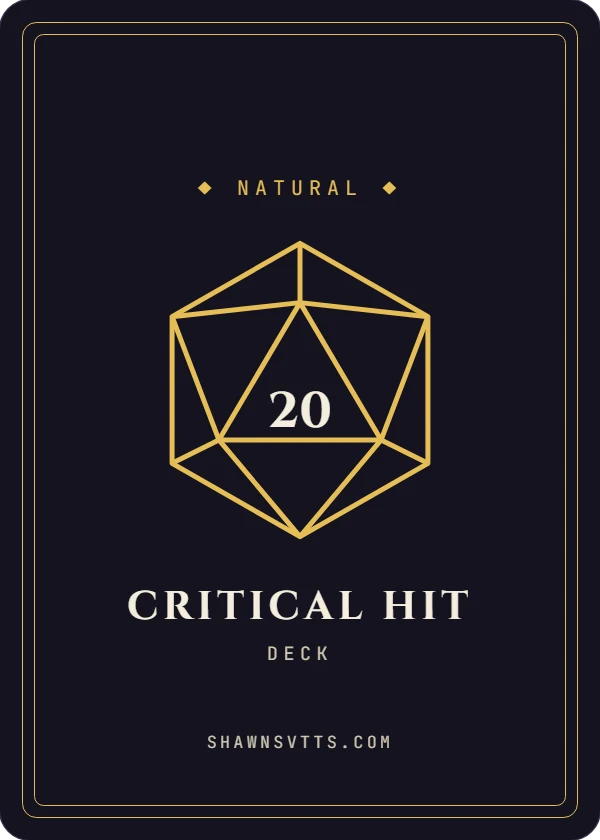
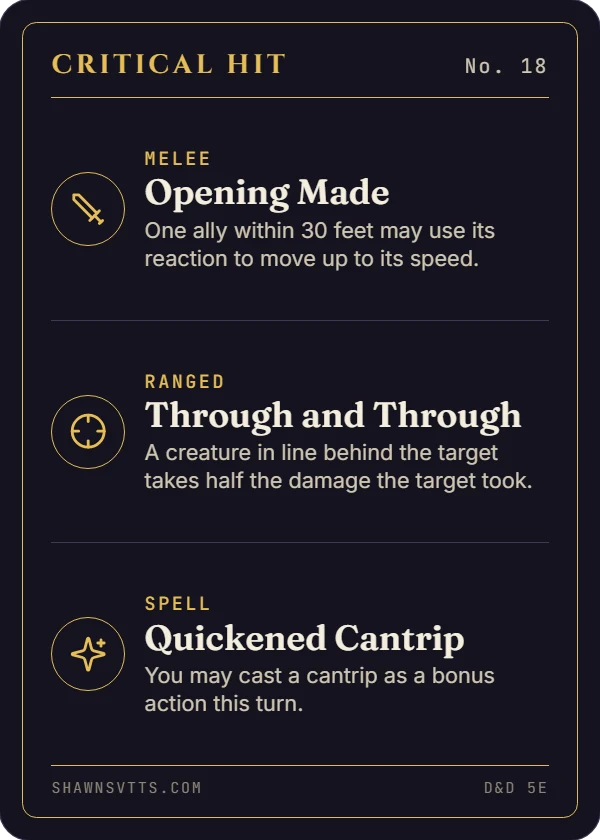
The Critical Hit Deck's back: a d20 showing a natural 20.A Critical Hit card in the Noir look, gold on dark, with a melee, a ranged and a spell effect.

◆ Natural 20

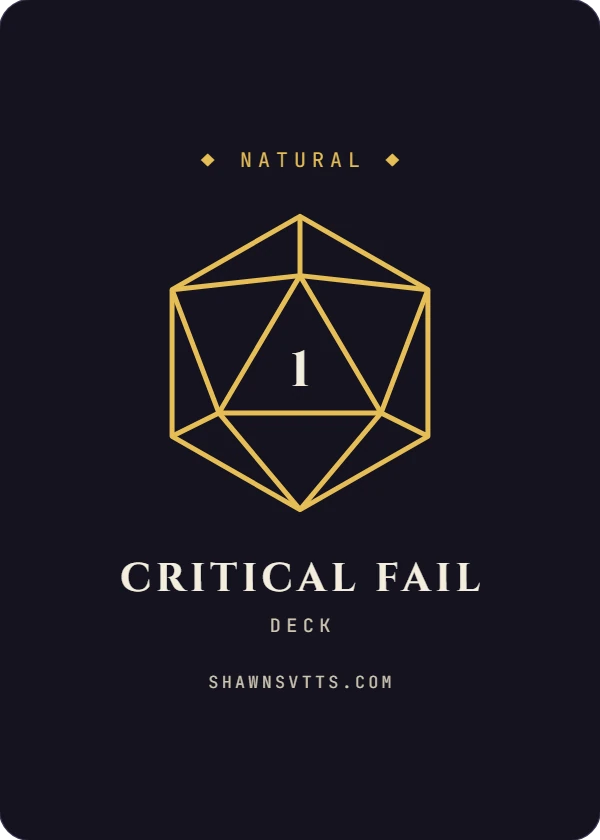
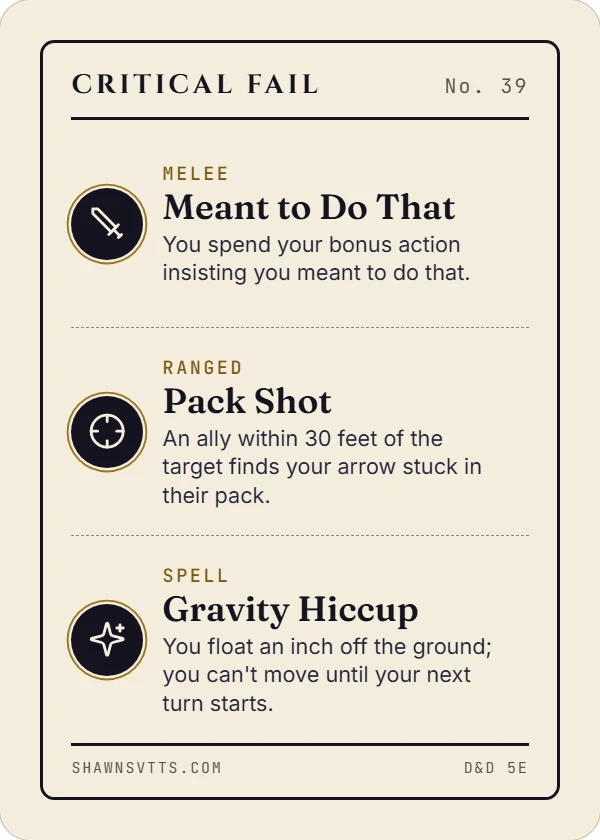
The Critical Fail Deck's back: a d20 showing a natural 1.Critical Fail card No. 39 in the Rulebook look: Meant to Do That, Pack Shot and Gravity Hiccup.

◆ Natural 1

Print them free. Want the shared table? I’m working on a space where the DM and players roll dice and draw these cards together on screen, for members only. It isn’t ready yet. Members also get a new Stolen Rules volume every month and every Foundry module.

Join →

◆ One deck for each end of the d20

How it plays

◆ Natural 20

Critical Hit Deck

Your best roll does something.

  1. 01Roll a natural 20 on an attack, then draw one card.
  2. 02Use the row that matches the attack you just made: Melee, Ranged or Spell.
  3. 03Roll critical damage as normal. The card adds an effect on top. The Rules card has a Deadly Variant for tables that want monsters drawing too.

◆ Natural 1

Critical Fail Deck

Your worst roll makes a story, not a lost turn.

  1. 01Roll a natural 1 on an attack, then roll the attack again.
  2. 02If that misses too, draw one card and use the row that matches your attack: Melee, Ranged or Spell.
  3. 03One card per turn at most. The attack still misses and the card adds a mishap on top. The Harsh Variant skips the second roll.

Use one deck or both. They share a size, a card back and three looks, so they sit side by side at the table and you can tell them apart by the number on the die.

◆ Three effects, one for every attack

What’s on the cards

Every card has a melee effect, a ranged effect and a spell effect. Use the row that matches the attack you just made. Critical hits lean on the conditions you already know, like prone, blinded and grappled, plus shoves, pins, free movement for an ally and the odd bit of luck.

Fumbles happen to the person who rolled the 1, and they stay small: a dropped weapon, a stumble, a shot that lands near a friend, a spell that fizzles. Nothing lasts past a short rest, nothing kills you, and a few cards in every row cost nothing but your dignity. Here is one card from each deck, as printed:

CRITICAL HITNo. 07
  • Melee

    Hamstring

    The target's speed is halved until the end of its next turn.

  • Ranged

    Sniper's Focus

    Your next ranged attack before the end of your next turn deals an extra 1d6 damage.

  • Spell

    Altered State

    You may change this spell's damage type to acid, cold, fire, lightning, or thunder.

CRITICAL FAILNo. 39
  • Melee

    Meant to Do That

    You spend your bonus action insisting you meant to do that.

  • Ranged

    Pack Shot

    An ally within 30 feet of the target finds your arrow stuck in their pack.

  • Spell

    Gravity Hiccup

    You float an inch off the ground; you can't move until your next turn starts.

◆ Before you print

Questions

What size are the cards?

Poker size, 2.5 by 3.5 inches, so standard card sleeves fit. The files print on US Letter or A4, eight cards to a sheet, with crop marks to cut on. Both decks share the size, the backs and the three looks.

Does it work with the 2024 rules and the 2014 rules?

Yes. The effects are written for fifth edition and lean on conditions, saving throws and actions that mean the same thing in the 2014 and 2024 rulebooks, so both decks drop into either one.

Won’t a fumble deck punish fighters, who attack more often?

That is the usual complaint about fumble tables, so this deck asks you to confirm the fumble: on a natural 1, roll the attack again, and draw only if that misses too. You draw at most one card per turn, so a fighter with three attacks only pays for a real whiff.

Do monsters draw cards too?

For critical hits, the DM draws for a monster only when its challenge rating is equal to or higher than the target’s level, and the Deadly Variant lets every monster draw. For fumbles, monsters draw only if your table agrees. Warn your players before you switch either one on.

Does a card replace my critical damage, or end my turn on a 1?

Neither. On a natural 20, roll critical damage as normal and the card adds one effect on top. On a natural 1, the attack misses as usual and the card adds a mishap. Fumbles are short: nothing lasts past a short rest and nothing is permanent.

Do I need both decks?

No. Each deck works on its own, so use just the crits if your table hates fumbles. One signup sends you both, and you can print one now and the other later.

Is it really free?

Yes. Give your email, confirm it, and every file for both decks opens. Members get more, such as a new Stolen Rules volume each month and every Foundry module, and they will get the shared table when it is ready.
I’ve been a Game Master for 44 years. I build Wyrmfall, a free virtual tabletop for fifth edition.

See Wyrmfall →