Faction Turns in Stars Without Number
Faction Turns in Stars Without Number
Faction turns are the subsystem most Stars Without Number GMs try once and quietly stop running. Not because the rules are bad — because the bookkeeping lands entirely on one person, between sessions, with no audience. This is how the subsystem works, how we've built it into the VTT, and how to run it so it survives past session three.
What Faction Turns Actually Do
Between sessions, or every in-game month, each major organization in the sector takes a turn. They spend their resources on actions: moving assets around the sector, attacking rivals, buying influence on a new world, repairing what got broken last turn.
The point is not simulation. The point is that the sector changes whether or not the players were involved. A campaign where the political situation only moves when the party pushes it is a campaign where the players are the only real thing in the setting. Faction turns are the cheapest way to make the background move on its own.
That's the payoff. The cost is admin, and the admin is what kills it.
Setting Up Factions
In the Faction Manager, reachable from the sector map panel, each faction gets:
- Name and description
- Starting stats: Force, Cunning, Wealth
- Starting HP, derived from asset health
- A homeworld, which anchors it to a hex on the sector map
Force is direct violence. Cunning is espionage, subversion, information. Wealth is trade, bribery, industry. Most interesting factions are strong in one and weak in another — a merchant combine with deep Wealth and no Force has to buy its protection from someone, and that relationship is an adventure hook you did not have to write.
Creating Assets
Assets are what a faction owns and spends: informers, strike craft, propaganda campaigns, trade fleets. Each has a type matching one of the three stats, a purchase cost, a rating, and a world it currently sits on.
Select a faction, click Add Asset, choose from the list. The VTT checks affordability and stat prerequisites before it lets the purchase through, so you can't accidentally give a Force 1 faction a capital ship and discover the mistake four turns later.
Running a Turn
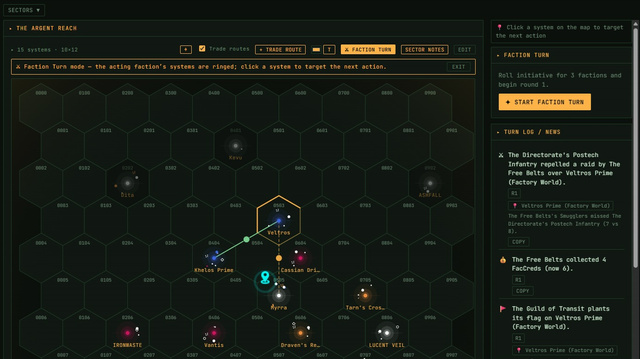
1. Open the Faction Turn panel from the sector map sidebar. 2. For each faction, choose an action: - Attack: target an enemy asset on the same or an adjacent world - Move Asset: relocate along travel routes - Refit: restore HP to something damaged - Expand Influence: pay to establish presence on a new world - Sell Asset: liquidate for half cost 3. Resolve attacks. The VTT rolls attacker stat against defender stat and applies the result. 4. End the turn. Outcomes are logged and asset HP updates on the map.
Why Tables Abandon It, and What To Do Instead
Running every faction every turn. This is the big one. Eight factions at five minutes each is a forty-minute chore with no players in the room, every week, forever. Nobody sustains that.
Run two or three factions properly and let the rest be implied. An implied faction is one you narrate a result for without resolving mechanics: the shipping cartel had a good quarter, the local government is still distracted. If the party turns their attention to an implied faction, promote it to an active one and give it real stats then. Detail is a cost you should only pay where someone is looking.
Doing it in silence. A faction turn nobody sees is invisible work. Whatever moved, put it in front of the players — a news item at the top of session, a rumour in a bar, a changed patrol on the map they can see. If they cannot perceive the change, it did not happen as far as the campaign is concerned.
Treating it as a separate game. Faction turns are prep, not a parallel campaign. If a turn's outcome doesn't generate a hook, a complication, or a change the party can see, you can skip resolving it and just record the state.
Letting it run ahead of the party. Factions that resolve their goals entirely offscreen leave the players spectators. When a faction is one turn from something dramatic, stop and let the party get in front of it.
How Long a Turn Should Take
Two or three active factions, once between sessions, is about five to ten minutes once you're used to the panel. If you're regularly spending longer, you have too many active factions, not a process problem.
Some GMs prefer to run the turn live at the top of the session, narrating as they go. That works well when players are invested in the political layer, and it converts the admin into table time rather than adding to prep.
Making Players Care
Show them the map. The faction overlay exists so the political situation is a thing players look at rather than a thing they're told. A party that can see military assets massing two hexes from their base of operations will act on it without being prompted.
Let them join in. Players who buy into a faction, or found one, turn the subsystem from background texture into something they're playing. A party-run faction with two assets and a bad Wealth score generates more session hooks than four NPC factions combined.
Use outcomes as hooks, not as news. An asset destroyed on a world the party knows is a job. Someone has to find out who did it. That is more useful than a summary of what happened while they were away.
Where It Lives in the VTT
The Faction Manager and the Faction Turn panel are both reachable from the sector map sidebar, and faction presence renders directly on the map via the faction overlay. Everything saves automatically, so the state you leave at the end of a turn is the state your players find at the start of the next session.
If you're setting up a campaign from scratch, the sector map guide covers generating the sector these factions will fight over.